
Ceremonial Burial: The Crucible of Agriculture and the Origins of “Futures Thinking”
We are not the “farming ape”; we are the “foresight ape,” and our first fields were our graveyards.
Summary
The transition from foraging to farming is traditionally viewed as a reactive strategy to environmental shifts or social competition. However, these models often bypass the profound cognitive evolution required to “invest” a resource into the earth for a deferred, symbolic gain. This article proposes that Ceremonial Burial served as the primary cognitive laboratory for agriculture. By transforming the soil into a vessel for the future—first for the dead and subsequently for sustenance—early humans developed the foundations of Futures Thinking and Foresight. We argue that the “abstract leap” from present-tense survival to a narrative-driven future was forged in the graveyard, where the ritualized feeding of the dead and the demarcation of ancestral lands accidentally birthed the cultivation of the living.
I. The Cognitive Barrier: From Food Caching to Narrative Foresight
In the study of Futures Literacy, a distinction is made between “instinctive anticipation” and “conscious foresight.” While many species (e.g., squirrels, corvids) cache food, these are biologically driven “present-tense” behaviours—a reaction to immediate environmental cues.
- The Abstract Leap: Agriculture requires a “narrative future.” It demands that a human withhold food from a hungry child today to bury it in the dirt for a tomorrow that is not yet guaranteed and exists only in the mind.
- The Living Narrative: As humans evolved, they began to live not just in the environment, but in a narrative that stretched beyond the biological “now”. This shift allowed for “Autonoetic Consciousness”—the ability to mentally project oneself into a different time, and the practice of Ceremonial Burial is one of the first pieces of evidence of this. By “storing” a body in the earth, humans moved from a purely extractive relationship with nature to a model of deferred presence. The dead were no longer “gone”; they were “elsewhere,” awaiting a future interaction.
II. The Grave as an Accidental Laboratory: From Beads to Seeds
Before humans ever buried a seed, they had a long, cross-species history (spanning back to Homo naledi and Neanderthals) of burying the dead with high-value items. The “Grave-Side Cultivation” hypothesis speculates that the physical act of burial unintentionally optimized the environment for domestication, as decaying organic matter (and offerings) turned burial sites into “hotspots” of fertility. By treating the earth as a repository for the ancestors, humans accidentally discovered the mechanism of the harvest.
- Ritual Investment: Excavations of Upper Palaeolithic graves reveal a staggering investment of labour: thousands of mammoth ivory beads, finely crafted flint arrowheads, and rare pigments like red ochre. These objects were “killed” or removed from the economy of the living to serve a future purpose in the afterlife.
- The Biological Offering: As humans intensified their relationship with plants, food became the ultimate sacrifice. If high-value wild grains were left as offerings on graves, the disturbed, nitrogen-rich soil of the burial site—constantly churned by human activity—would yield a dense, “miraculous” crop of grain a year later, creating a visual and conceptual link between burial and growth.
- Scientific Evidence: At Raqefet Cave (13,000 BP), Natufian burials were found with thick linings of flowering plants. This suggests that the “discovery” of agriculture was likely an empirical observation of ritual sites: return to an ancestor’s grave, find a garden.
III. The Mythological Engine: Death, Rebirth, and Reciprocity
The simultaneous emergence of agriculture globally (Fertile Crescent, Yangtze, Mesoamerica) suggests a shared cognitive evolution rather than a single point of origin.
- The Dying God Motif: Across nearly all early agrarian cultures, there is a foundational myth of a god who must die to become the crop (e.g., Osiris, Attis, Persephone, the “Three Sisters” in the Americas). This reflects a deep-seated psychological connection between the cemetery and the field.
- Ancestral Reciprocity: As noted by Jacques Cauvin in The Birth of the Gods, religion likely preceded the plough. Humans began “feeding” the dead; the subsequent growth of plants was interpreted as the dead “feeding” the living. This ritual loop reinforced the behaviour of planting. The mythic logic was reciprocal: “I feed the ancestor in the earth; the ancestor sends the grain back from the earth.”
- The Domesticated Dead: The transition to agriculture was often accompanied by the practice of burying the dead inside the houses, specifically under the floors (as seen at Çatalhöyük). By keeping the ancestors beneath their feet, early farmers integrated the dead into the daily “work” of the household. The ancestors became protective forces whose favour was required for a successful harvest.
- The Toraja Parallel: We see modern echoes of this in the Toraja culture of Sulawesi, where the dead remain with the family for years, treated as “sleeping” participants. Their Ma’nene ritual—where the dead are exhumed, cleaned, and offered food—demonstrates that the dead are viewed as active social participants, a worldview where the past (ancestors) and future (harvest) are part of a single, continuous story.
IV. Ecological Pressure: The Younger Dryas as a Creative Catalyst
While the cognitive “hardware” for agriculture was likely in place for millennia, it required a “software” update—a tipping point.
- The Global Squeeze: Between 10,800 and 9,500 BCE, the Younger Dryas plunged the world back into near-glacial conditions. This ecological pressure was felt globally: in the Fertile Crescent (wheat/barley), the Yangtze (rice), and Mesoamerica (maize).
- The Tipping Point: While humans had practiced “proto-farming” behaviours for millennia, this crisis forced a shift from observation to intervention. The “Futures Mindset” cultivated through burial allowed humans to respond creatively rather than desperately.
- The Foresight Response: Rather than retreating into nomadic desperation, the “Futures Mindset” cultivated through ritual allowed humans to be creative. Faced with failing wild stands, humans applied the logic of the grave ritual: If we sacrifice/bury it now, it will return later. This might explain the near-simultaneous emergence of farming across diverse cultures around the world. It wasn’t a shared technology, but a shared cognitive response to stress, mediated through the universal behaviour of ancestor worship.
V. The Saxe-Goldstein Hypothesis: Graves as the First Land Deeds
The leap to agriculture required more than just the knowledge of seeds; it required the territoriality to protect a field. This is where the Saxe-Goldstein Hypothesis (Hypothesis Eight) provides a crucial link.
- The Ancestral Claim: Anthropologist Arthur Saxe and archaeologist Lynne Goldstein argued that formal, specialized cemeteries appear when a “corporate group” (a tribe or lineage) needs to legitimize its claim to restricted, vital resources.
- The Territorial Pivot: By burying ancestors in a specific plot, the living created a permanent “legal deed” to that land. Before the first fence was ever built, the cemetery served as the boundary. The transition from material offerings (flint arrowheads, ivory beads, and ochre) to biological offerings (food and seeds) meant that the “ancestral land” was not just where the dead rested, but where the food “miraculously” returned. This made the ground itself a repository of future value.
VI. Göbekli Tepe: The Monument to Foresight
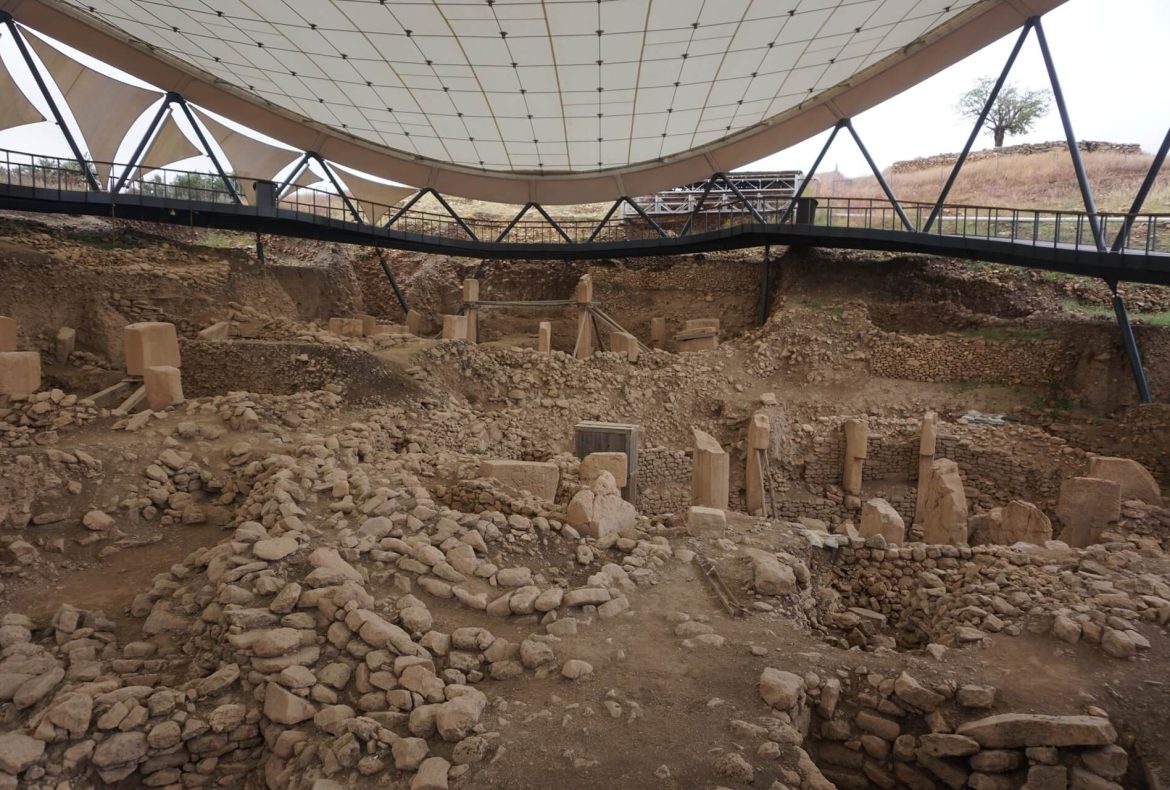
The discovery of Göbekli Tepe (c. 9,500 BCE) potentially flipped the traditional “Agriculture → Religion” timeline and serves as a possible ultimate proof that the “Temple” (and the Grave) created the “Farm.”
- The Logistics of Ritual: Built by hunter-gatherers, the site required the coordination of hundreds of people. To sustain such a workforce, as well as the visiting pilgrims, the builders had to practice Strategic Foresight—planning food logistics months in advance.
- From Ritual to Surplus: The site lacks permanent domestic housing but is filled with evidence of massive feasts. The demand for these ritual gatherings likely forced the local groups to transition from opportunistic gathering to the intensive cultivation of wild wheat found nearby. In this sense, the religious imagination “invented” the surplus that agriculture then provided.
VII. Conclusion: The Birth of the “Futures” Mindset
Agriculture was not merely a change in diet; it was the finalization of the human “narrative” and the birth of Futures Thinking. It marked the moment when Foresight became more important than Foraging.
- Burial taught us that the ground can hold value and that “hidden” does not mean “lost.”
- Ritual taught us that the future can be influenced by present action and sacrifice.
- Agriculture was the ultimate scaling of this foresight—a massive, society-wide exercise in Futures Literacy.
We must reconsider the Neolithic Revolution not as a series of botanical accidents, but as a ritualized triumph of the imagination. We did not start farming because we were hungry; we started farming because we had learned how to live in the future.
We are not the “farming ape”; we are the “foresight ape,” and our first fields were our graveyards.
Key Research Sources for Reference:
- Saxe, A. A. (1970): Social Dimensions of Mortuary Practices.
- Goldstein, L. (1981): One-Dimensional Archaeology and Multi-Dimensional People.
- Cauvin, J. (2000): The Birth of the Gods and the Origins of Agriculture.
- Watkins, T. (2010): New Light on Neolithic Religious Technology.
- Hodder, I. (2011): The Leopard’s Tale: Revealing the Mysteries of Çatalhöyük.
- Miller-Rosen, A. & Rivera, I. (2012): The Role of Ritual and Environment in the Origins of Agriculture.
- Schmidt, K. (2012): Göbekli Tepe: A Stone Age Sanctuary in South-Eastern Anatolia.
- Nadel, D., et al. (2013): Soft burials: The use of plant linings in Natufian graves.
- Dunbar, R. (2014): Human Evolution. (The social brain and the transition to the Neolithic).
